
Where to Invest in AI for Maximal ROI
Part I covered why AI projects fail. Part II established a governance framework around two axes - internal vs. external, advisory vs. acting - that determines what controls each class of AI deployment requires. This part addresses where to actually invest.
The Investment Paradox
If you are reading up on optimal AI investment strategies, you might come across the following paradox: Approximately 70% of integrated AI budgets flow to sales and marketing [1], but the most consistent measurable wins come from back-office automation. Reduced outsourcing spend, eliminated BPO contracts, lower agency fees, and consultants replaced by AI-powered internal capability, can generate $2-10M annually in cost reductions [1].
This might lead one to think that sales and marketing AI implementations lack value, but in our experience this is not the case. Rather, it is that sales and marketing outcomes are intrinsically harder to attribute. Market conditions, pricing, competitive activity, and seasonality all influence results simultaneously, which makes measuring the AI contribution difficult.
Only 5% of companies are achieving AI value at scale, while 60% report minimal revenue and cost gains despite substantial investment [2]. Despite accelerating adoption, the proportion of organizations reporting positive impact from GenAI declined year over year across every enterprise objective assessed - including revenue growth, cost management and risk management. Nearly half reported that no single enterprise objective had seen a strong positive impact from their GenAI investment [3]. The 5% that do capture value achieve 1.7x revenue growth, 1.6x higher EBIT margins, and 3.6x total shareholder returns compared to laggards [2].
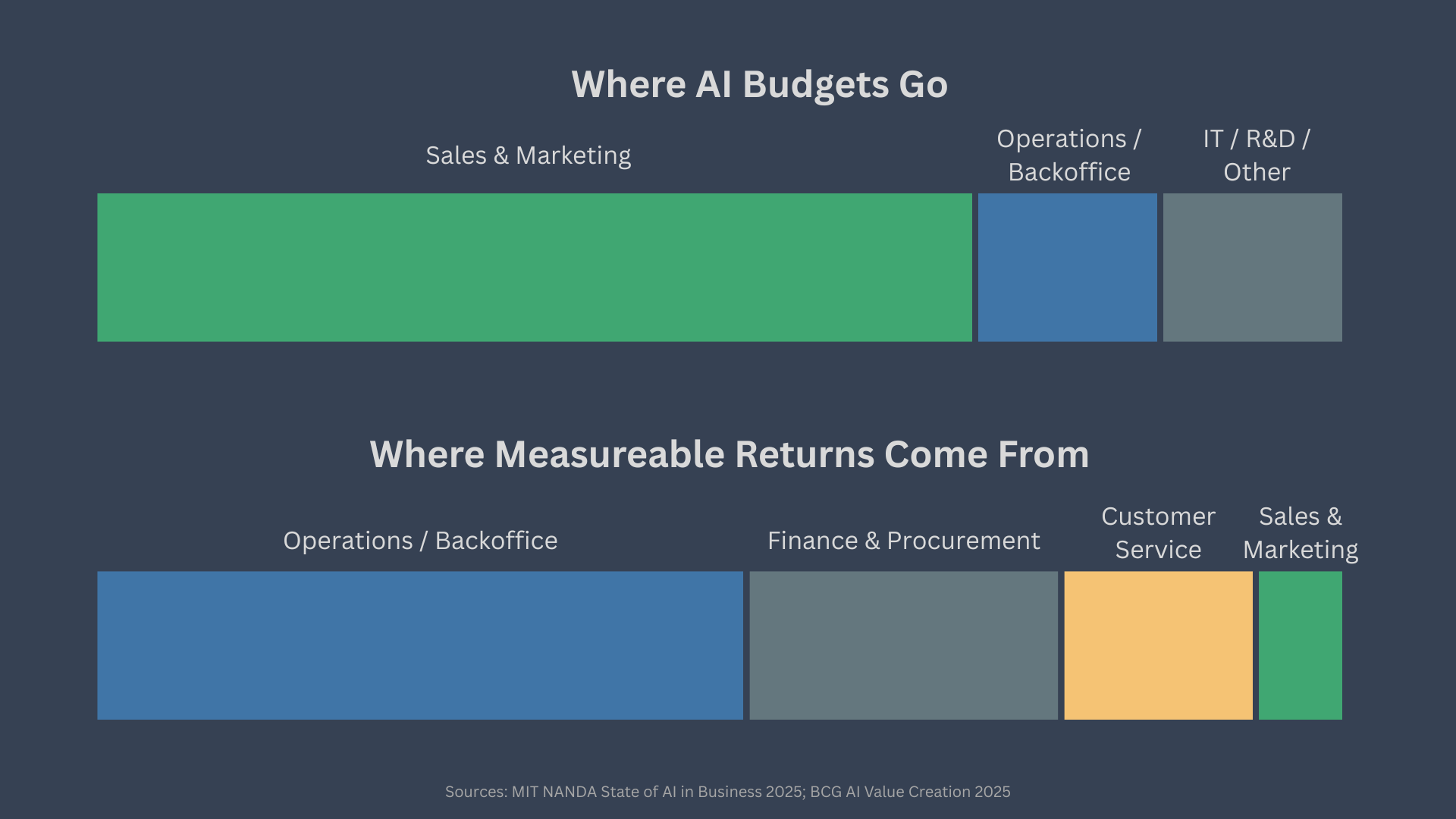
As we will see in this article, there are high value opportunities for the application of AI in all business areas. We argue that what makes AI projects successful is less about the business area you chose to invest in, and more about making sure your organizational maturity is aligned with the challenges you set out to solve. Delving into too large undertakings too early is a common failure mode. Being able to measure the success of your project is a key ingredient for success - and that is one of the main reasons why we frequently recommend starting with AI within operations.
Organizations that start with operations and finance build the data pipelines, accuracy benchmarks, and monitoring practices that make every subsequent deployment - including sales and marketing - easier to evaluate and more likely to succeed.
This brings us back to the governance framework from Part II. The quadrants - internal vs. external, advisory vs. acting - are not just a governance tool. They also describe a natural investment sequence.
The Quadrants as Investment Sequence
Part II introduced four quadrants to determine what governance each deployment needs. Those same quadrants also answer a different question: where should integrated AI investment go first? The maturity-linked progression from Part I - start small, build organizational capability, then extend - finds its concrete expression here.
Organizations that succeed start in the internal quadrants - AI connected to internal data, serving internal users - before extending to external-facing deployments. Within each row, they typically start with advisory systems (AI that informs human decisions) before moving to acting systems (AI that takes action autonomously).
Each quadrant builds capability that the next one depends on:
Internal Advisory is where AI reads internal data and surfaces recommendations to employees. Document summarization, contract analysis, call transcription for internal review. The data pipelines, accuracy benchmarks, and monitoring practices built here become the foundation for everything else.
Internal Acting is where AI begins to take action within the organization - routing workflows, processing invoices, reallocating resources. This requires permissions architectures, rollback capability, and audit trails as described in Part II. While these are built specifically for the Internal Acting phase, the data discipline and monitoring practices developed as part of Internal Advisory use cases make them substantially easier to implement well.
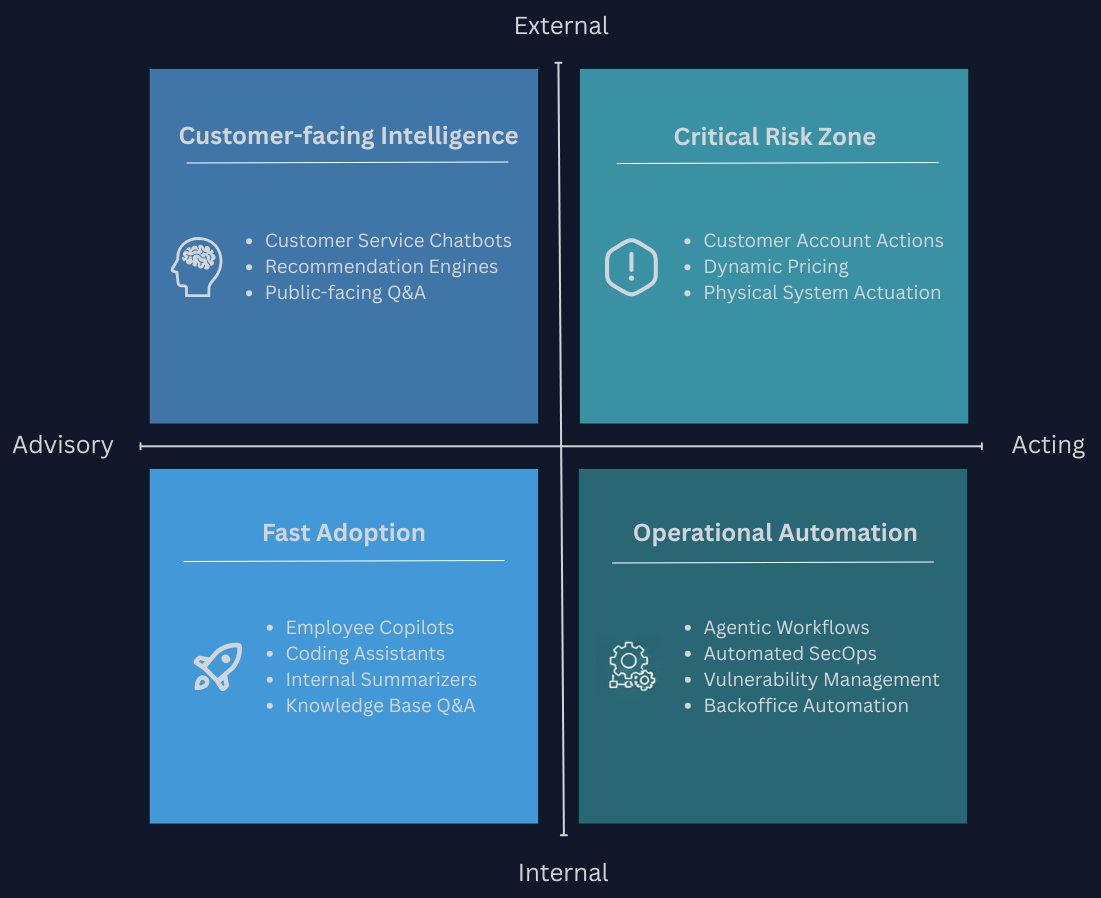
External Advisory is where AI output reaches people outside the organization - customers, suppliers, partners - in an informational or supportive capacity. AI-drafted customer communications, supplier risk assessments shared with procurement partners, AI-generated reports delivered to clients. The hallucination containment and output validation practices built during the internal quadrants now become essential because the reputational stakes are external. Organizations that skipped those stages typically discover the gap here.
External Acting is where AI output carries direct consequence for people outside the organization - the highest-risk quadrant and the one organizations most frequently attempt before they are ready. The investment point is simpler: every capability built in the preceding three quadrants - data discipline, monitoring, permissions, hallucination containment, output validation - is a prerequisite here. Organizations that arrive at this quadrant having earned their way through the previous three are materially better positioned than those that try and start here.
AI success breaks down into roughly 70% people and processes, 20% technology infrastructure, and only 10% algorithms and models [4]. The quadrant progression reflects this: each step is less about deploying new technology and more about building the organizational muscle - data governance, monitoring, escalation processes, effective human-AI collaboration - that the next step requires.
Applying the Framework by Business Area
As discussed during the introduction, there are high value opportunities for the application of AI in all business areas. Below, we give examples of how AI can be applied in each business area, and the measurable returns that can be achieved.
Operations
Internal Advisory: Document Processing and Internal Knowledge Retrieval
Start in a place where you have well defined processes that can be measured, and where some ambiguity of the AI contribution is permissible. Classifying incoming requests or summarizing internal documents are good examples. An energy company deploying AI to surface maintenance history and technical documentation across thousands of assets gives field engineers answers in seconds that previously required hours of manual search [5].
This is also where the buy vs. build question matters most. Vendor-built tools succeed 67% of the time, compared to one-in-three for internal builds [1]. At this stage, this gap is unsurprising. The use cases are well-understood, the tooling is mature, and there is little to gain from building what already exists. In our experience, the less obvious benefit is what a disciplined vendor deployment teaches the organization about itself - its data quality, process gaps, and adoption readiness. That learning feeds every subsequent deployment. A bespoke build consuming the same team for months longer typically does not.
Internal Acting: Dynamic Resource Allocation & SecOps
This represents the shift from informing to doing. Wind farm operators using AI to predict turbine component failures can plan interventions at a third of the cost of emergency repairs, while reducing unplanned downtime and improving power delivery reliability [6]. At scale, these systems progress from surfacing predictions to triggering work orders, scheduling crews, and pre-ordering parts autonomously.
SecOps automation is one of the highest-value operational use cases we see - and our core domain. Security operations centers face thousands of alerts daily, and a substantial share go uninvestigated simply because teams lack capacity. AI-driven triage that enriches alerts, correlates signals, and prioritizes analyst queues delivers immediate value by reducing alert fatigue and freeing analysts for higher-value investigation. Automated containment of high-volume low-risk alerts significantly improves the security posture of the organization. For impactful actions, human-in-the-loop workflows ensure system safety, while still realizing automation gains.
Transformation of operations workflows to include AI agents is moving ahead at pace. Agents already account for 17% of total AI value and are expected to reach 29% by 2028 [2]. However, while 46% of companies are experimenting with or deploying agents, only 16% of these are demonstrating tangible value. This goes to reaffirm our belief that it is critical to start small and build organizational capability gradually.

The highest-value agentic deployments combine routine automated execution with human approval gates at irreversible decision points. Operations is where this pattern works best: the processes are well-defined, the data is structured, and the cost of getting it wrong is bounded when the right controls are in place.
Finance & Procurement
Internal Advisory: Spend Analysis and Contract Intelligence
This is a natural starting point. As an example, Pentair deployed AI-powered procurement analytics globally in two months. The system classifies spend, consolidates supplier records, and surfaces savings opportunities. Results: over 90% accuracy in spend classification, 10% improvement in supplier consolidation, and $15M in working capital improvement through payment terms negotiation [7].
Internal Acting: Expenses & Accounts Payable Automation
Tools for expense automation have already been around for a while and have proven to deliver significant value. As long as workflows and approval processes are well-designed, AI can substantially reduce human effort and improve accuracy, while also enabling additional capabilities such as fraud detection. The critical element is to design for a certain level of fuzziness and to leverage the scalability of AI rather than to try and make it overly accurate.
External Acting: Autonomous Vendor Negotiation
Walmart uses AI to negotiate directly with thousands of tail-end suppliers on contracts that would not justify a procurement manager's time. The AI communicates with human vendors, makes counter-offers, and closes binding agreements based on pre-set parameters. Results: deals reached with 68% of suppliers approached, average savings of 3%, and negotiation times reduced from weeks to days. Three out of four suppliers preferred negotiating with the AI over a human [8]. Human procurement officers retain the ability to modify parameters, and deadlocked negotiations escalate to humans. But the AI is conducting binding interactions with external parties autonomously.

Finance and procurement operate on structured data with well-defined rules. The value of automation is directly measurable in cost and time. One study reports a 38% enhancement in productivity and a 40% reduction in operational costs for finance operations [9].
Customer Service
Internal Advisory: Call Enrichment and Summarization
Call summarization alone can recover significant agent time per interaction - time previously spent on post-call documentation that now goes to higher-value work. Already during customer calls, AI can help by surfacing additional relevant information for context, all while keeping the human operator in control of the customer interaction.
External Advisory & External Acting: AI-powered Customer Chatbots
With the above examples implemented, it might seem like a small step to deploy a customer chatbot. However, experience shows that such direct external exposure presents a step change in risk and should be approached with caution.
Klarna's AI chatbot rollout was highly successful in terms of efficiency, handling two thirds of customer conversations, but was discontinued due to quality concerns [10]. Cursor, the AI coding assistant valued at nearly $10 billion, saw a wave of customer cancellations after its AI support bot hallucinated a fictitious policy change - an entirely fabricated explanation presented with full confidence to paying customers [11].
These are well-resourced technology companies, and they still got it wrong. Tempting as it may be, we tend to advise to invest in AI adoption in other areas and only venture into customer-facing chatbots once solid groundwork has been laid to control for hallucinations and other AI misbehavior.

AI-powered customer service implementations can reduce cost to serve by 20 to 30 percent and increase revenue by 5 to 8 percent [12]. Early agentic AI adopters report meaningfully higher ROI specifically in customer service [13]. The qualifier matters: these are organizations that invested in data infrastructure and operational monitoring before deploying customer-facing systems. Start with internal customer service tooling. Build your data infrastructure and operational confidence. Extend to customer-facing systems once the foundation supports it.
Sales & Marketing
Internal Advisory: Campaign Optimization & Sales Productivity
There are several quick wins for AI adoption in marketing and sales. AI agents are great at generating content, researching, and preparing for calls. They can run competitive analyses, generate customer profiles, and design outreach campaigns. Sales professionals report using AI to cut post-call administrative time by up to 80% [14].
Internal Acting: Smart Lead Scoring & CRM Enrichment
What might sound trivial at first, comes with a few hurdles to overcome. Lead scoring that is not based on clean, integrated data pipelines is not worth the investment. CRM enrichment integrations need to be devised in a safe way to prevent data corruption. While these are obstacles that can be overcome, we have seen organizations attempting to leapfrog the data infrastructure and governance requirements and run into trouble.
External Acting: Autonomous Outbound Prospecting
AI agents that independently contact leads, qualify interest, and schedule meetings are already in production at scale - Salesforce reports that prospecting is among the top agent use cases, with 34% of sales teams with AI agents using them [15]. These systems interact directly with external parties on behalf of the organization. The governance requirements from Part II apply in full: the AI's outreach is the organization's voice. Poorly calibrated prospecting agents damage brand and erode trust in ways that are difficult to measure and slow to recover from.

The pattern across sales and marketing is consistent with the other business areas. Deploy individual tools broadly and immediately. For integrated deployments, build the data infrastructure first. The organizations extracting real value from lead scoring, forecasting, and autonomous outreach built their foundation in operations and finance before extending to domains where attribution is harder and exposure is higher.
Setting Expectations & Measuring Success
Most organizations achieve satisfactory ROI on a typical AI use case within two to four years [16]. The typical payback period expected for technology investments is seven to twelve months. In a survey of nearly 2,000 executives, only 6% reported payback in under a year [16]. This gap between expectation and reality is where many programs die. Programs abandoned at twelve months because P&L impact has not yet appeared are often cut precisely when the foundation is in place and returns are beginning to materialize.
Consequently, it is important to set realistic expectations, to align them to realistic timelines, and to set in place the right metrics to validate success along the way. Success metrics should not primarily be focused on activity, but on outcomes. Clear ownership from the business side is essential to ensure the project delivers meaningful value and receives the organizational buy-in required to succeed.
72% of workers already use AI regularly, but as was true for digitalization, true value requires deep workflow redesign, not merely tool deployment [17]. This requires organizational capability also through employee upskilling. While software companies plan to upskill 55% of their staff, firms in industrial sectors plan to train fewer than 15% [2]. The organizations generating the most value from AI spend the majority of their investment on people and process, not on the technology itself [18].
Organizations that redesign workflows end-to-end with AI achieve cost savings of up to 25%, while those running isolated AI experiments typically see 5% or less [4]. The pattern among leading organizations reinforces this. For every two dollars spent on technology, they spend three on process redesign and five on scaling and capability building [18]. The technology investment is the smallest part. The returns come from organizational readiness and workflow transformation.
Conclusion
Organizations capturing real value start internally, build operational confidence, and expand outward. They invest more in people and process than in models. They measure outcomes - cost per invoice, mean time to respond, lead conversion rate - not just adoption and usage. They set realistic timelines and resist the urge to cut programs before compounding effects take hold.
The investment question in AI is less about which technology to use and more about where and how to deploy it. Leveraging AI strengths while also accepting its limitations and (re)designing workflows accordingly is key to success.
Next in this series
The investment framework above provides strategic guidance - where to start, what to measure, and how to sequence. What remains is execution: when standing at the start of a specific deployment, what are the most important items to keep track of?
Part IV will distill the guidance from this series into an AI adoption checklist - to help you succeed with your AI initiatives and projects.